

customer story
Crack and micro-defect detection
Non-destructive testing by machine vision identifies cracks and micro-defects on welds and stressed parts in the nuclear and defense sectors, where zero tolerance is a must.
Contact usAn area that people rarely enter, where hardware that goes in never comes out, networks cut off from the Internet and a file to produce for every decision: installing vision-based inspection in the nuclear industry is as much about running a safety project as about machine vision. Here is what that changes, in practical terms.
Machine vision replaces the eye behind a viewing window, or the camera that is watched without anything being kept. It inspects the surface condition of parts and containers, measures dimensions without contact, monitors a process continuously and flags deviations before they become non-conformities. Every decision is backed by the image that prompted it, which makes it admissible in a file. The system is installed on a closed network: neither images nor models leave the site.
100 %
of parts inspected
Visual inspection in a glovebox or behind a viewing window relies on manual sampling; machine vision inspects every part that passes.
0
outbound data flows
No images, no models, no telemetry leave the facility's network.
1 image
per decision made
The evidence comes with the decision: traceability no longer relies on self-reported records.
Industry challenges
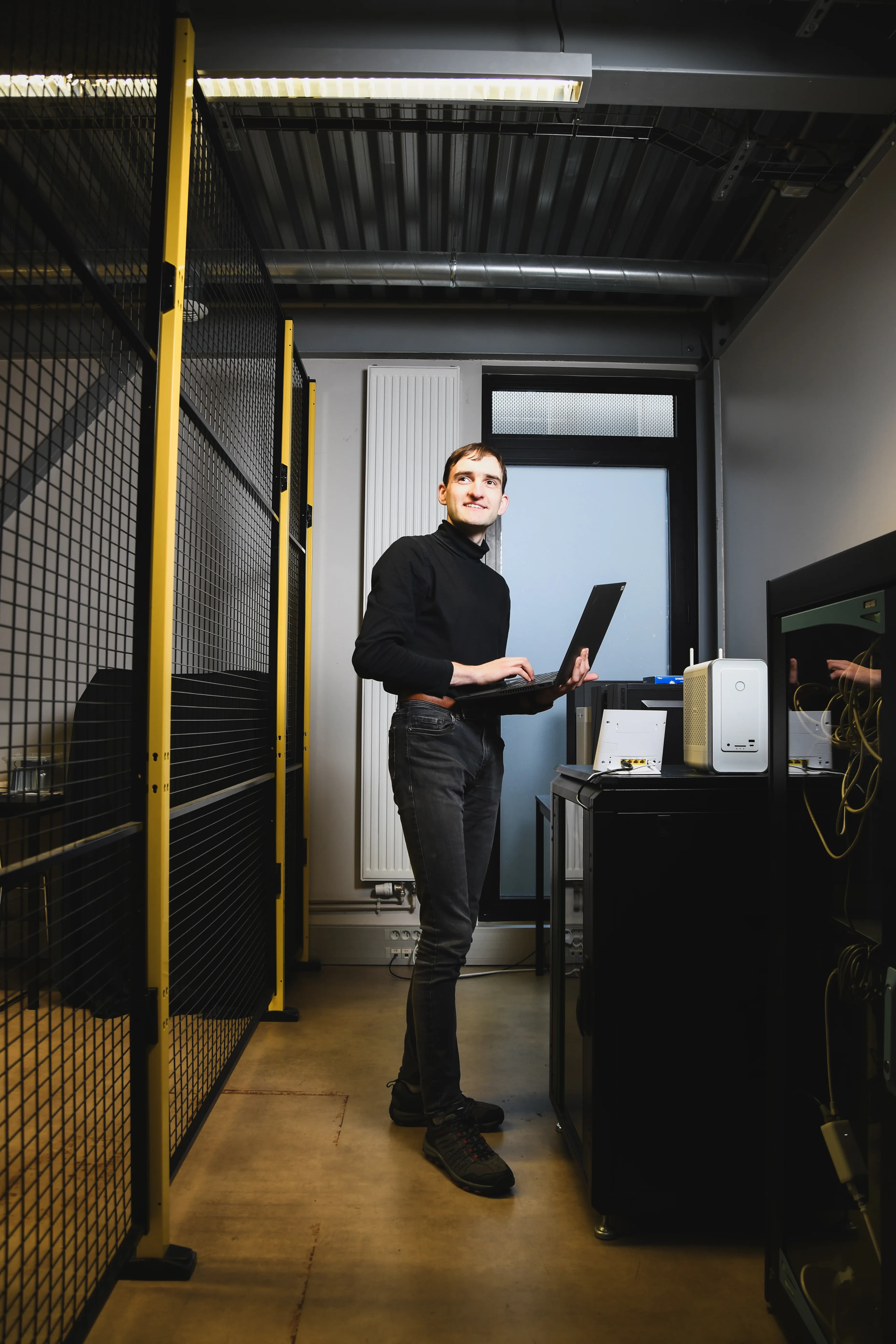
You do not enter a controlled area to adjust a light. Setup, calibration and maintenance must be designed to hold between two intervention windows.
What goes into the area stays there and ends up as waste. Component choice, cost and service life are therefore weighed differently than in a conventional plant.
No cloud, no open remote maintenance, no automatic updates. The system must run, learn and be updated offline.
Process images describe the facility. They can neither pass through a third-party service nor be used to train a model used elsewhere.
A reject, a sort, an alert: every output of the system must be explainable and reviewable months later. A black box does not pass a safety review.
Short runs, rare defects, parts that cannot be damaged for the sake of an example: the model must learn from far fewer images than elsewhere.
At the facility
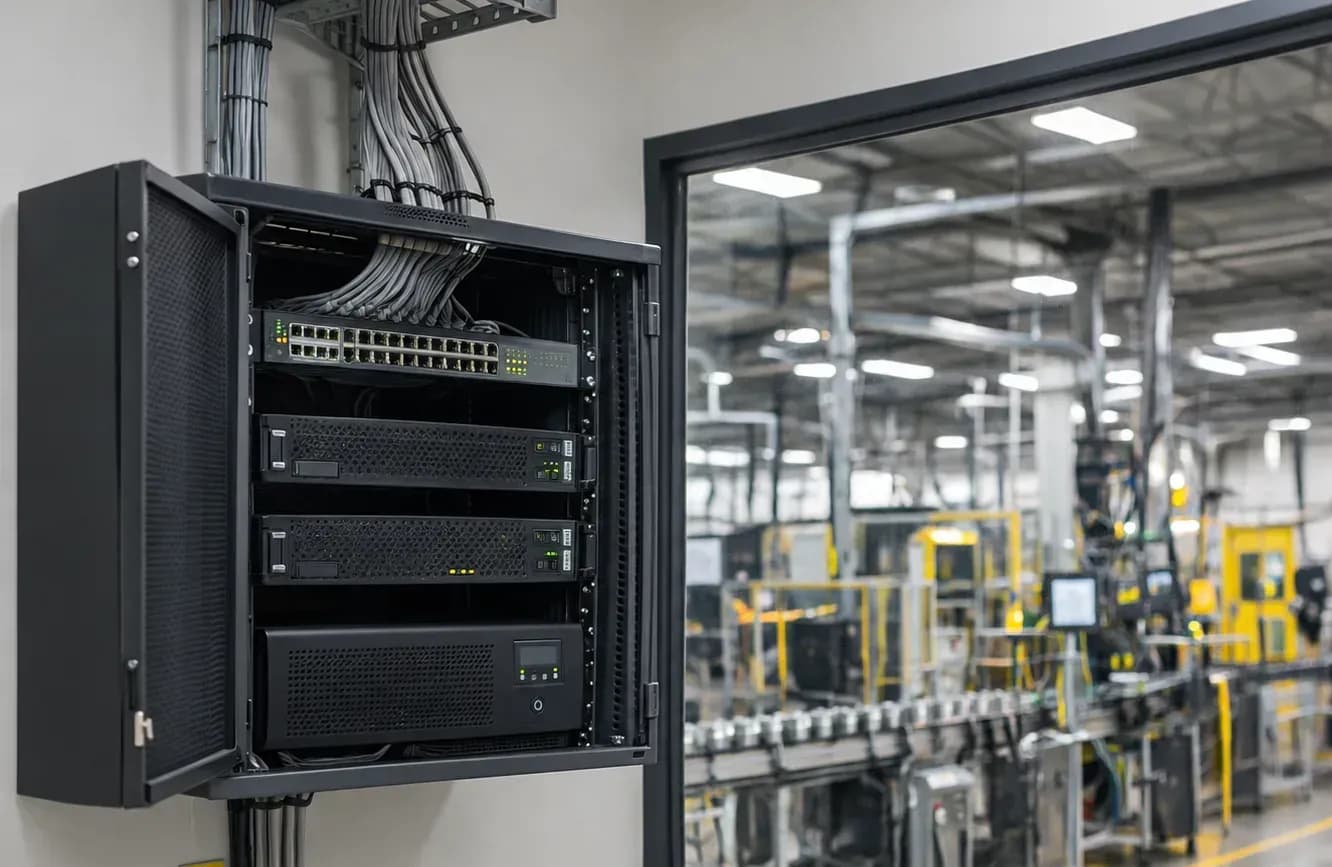
The vision station is delivered complete and runs with no outside connection: acquisition, processing, decision and archiving all run on the installed hardware. Updates are delivered through the channel defined by your operator, on the schedule of your intervention windows.
Mounting follows the same logic. Optics, lighting and housings are chosen bearing in mind that what goes into the area never comes back out, and interfacing with the existing PLC or supervisory system uses the protocols already in service, without opening any new data flow.
Sovereignty
Psycle is a French company, and its software is installed on your premises. Production images, annotations and trained models stay on your site: they are neither used to feed a shared model nor to supply a service hosted elsewhere.
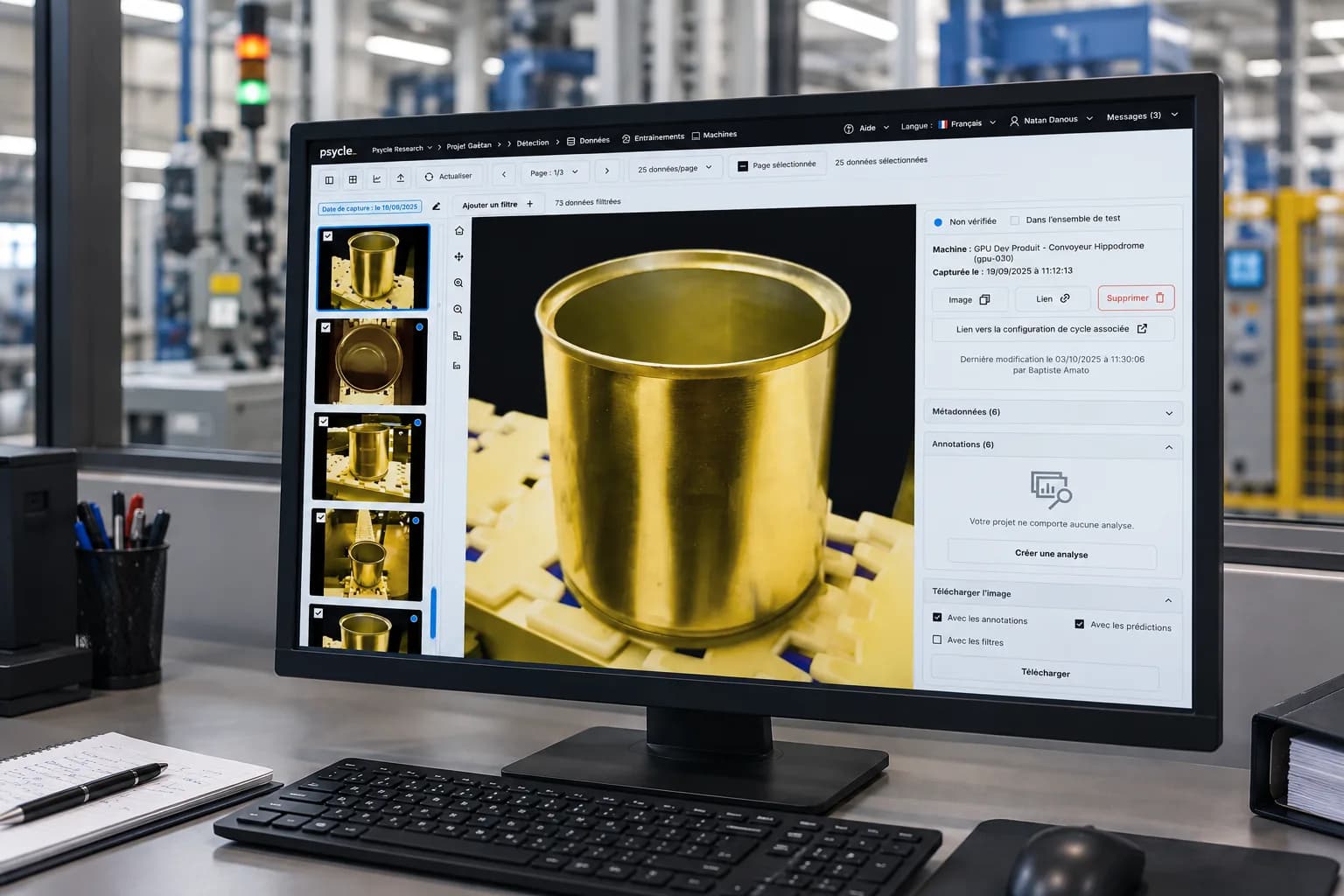
The way the system works is readable end to end: what triggered a decision, with which image, according to which model and on what date. It is this readability that makes the inspection defensible before a prime contractor as well as an auditor.
customer story
Non-destructive testing by machine vision identifies cracks and micro-defects on welds and stressed parts in the nuclear and defense sectors, where zero tolerance is a must.
Contact uscustomer story
Mounting the camera directly on the robot arm makes it possible to combine guidance and quality control in a single cycle, with no dedicated inspection station, reducing line footprint and cycle time.
Contact uscustomer story
Scratches, cracks, inclusions, porosity: automated vision inspection detects surface defects invisible to the naked eye on metal or plastic parts, however complex their geometry.
Contact usMethod
.01
The study starts from the images already available, or from representative non-active parts. It shows what can be detected before any hardware enters the area.
.02
Optics, lighting and model are locked in on a test bench, together with the protocol and the file that will be used for site acceptance.
.03
Mounting, PLC connection and verification are prepared to fit within the planned access window, with hardware declared in advance.
.04
New part reference, new defect, observed drift: the model is retrained on site, offline, with no outside intervention.
None of these constraints is negotiable, and each one translates into a specific technical choice rather than a contract clause.
| The constraint | What it determines in the system | |
|---|---|---|
| Controlled area | Rare access, non-recoverable hardware | Simple components, remote adjustment, planned maintenance |
| Segregated network | No cloud, no open remote maintenance | Local processing and training, updates delivered offline |
| Sovereignty | Images describe the facility | On-site storage, no model shared between customers |
| Records and safety | Every decision must be explainable | Image, model version and timestamp kept with the result |
| Short runs | Few parts, rare defects | Image-efficient learning, based on the notion of a normal part |
| Clearances | Declared personnel and hardware | Upstream preparation, on-site presence kept to what is necessary |
The intelligence Psycle brings is essential for obtaining a reliable result.
Julien Guinoiseau – Director
Aretec (groupe SOGAT)

Psycle's AI-assisted vision solutions fit perfectly into the culture of operational performance we have established in our plant.
Matthieu Rosenberg – Innovation Project Manager
Orano
Yes. Every step runs on the installed hardware: image capture, processing, decision and archiving. No external connection is required. Updates go through the channel defined by the facility operator, and the model is retrained on site, offline.
On your site, and nowhere else. Production images, annotations and models stay with you. They are not used to train a model shared between customers and do not pass through any third-party service. No telemetry is sent.
Each result is stored with the image that produced it, the version of the model used and the date. A scrapping decision, a sorting decision or an alert can therefore be reviewed and explained months later, to the facility operator as well as to a client.
The model mainly learns what a normal part looks like, then flags anything that deviates from it. It therefore needs far fewer images than an approach that would require many examples of defects. Nor do you have to damage parts to build a training dataset.
Everything is prepared upstream. The mounting, optics and model are validated on a test bench. The hardware is declared in advance, and the intervention is planned to fit within the scheduled access window. Components are chosen knowing that they will not leave the area again, and the settings are designed to hold from one intervention to the next.
Yes. The feasibility study starts from the images you already have, or from representative non-active parts. It establishes what is detectable before any hardware is committed to the installation.
psycle solutions
a Python framework compatible with computer vision standards (GenICam) and the latest deep learning models.