

use cases
Complex depalletizing
Mixed layers, disorganized packages, variable heights: 3D vision algorithms detect each unit and calculate the optimal unstacking sequence for autonomous operation without human intervention.
Contact usIn logistics, nothing ever repeats itself: the next package isn’t the same size, color, or weight as the previous one, and the incoming pallet is never quite straight. A vision system is used less to assess an individual item than to understand the overall scene: where the objects are, how to pick them up without knocking anything over, and what just happened in the flow.
Machine vision provides the robot with the actual position of the item it needs to pick up, without the need for a predefined product reference model. It maps the scene in three dimensions, recognizes packages it has never seen before, plans a pick that will not knock over either the adjacent stack or the package being picked, and flags any issues in the flow: a fallen package, an oversized pallet, torn packaging film, or an unreadable barcode. It thus serves both to take action and to determine what has happened.
30min
training
That is how long it takes for our depalletizing and unloading systems to learn how to handle a new product that the cameras have never seen before, so they can process it efficiently.
2D & 3D
combined
In addition to quality control, the stack height and tilt are assessed: the scene is measured before each shot, rather than being inferred from a palletization plan.
24 hours a day
without losing focus
The decision-making criterion is the same whether it's the first truck of the shift or the last one of the night.
1 picture
by reported incident
A dispute is settled based on a photograph of the scene rather than on the operator's recollection.
Industry challenges
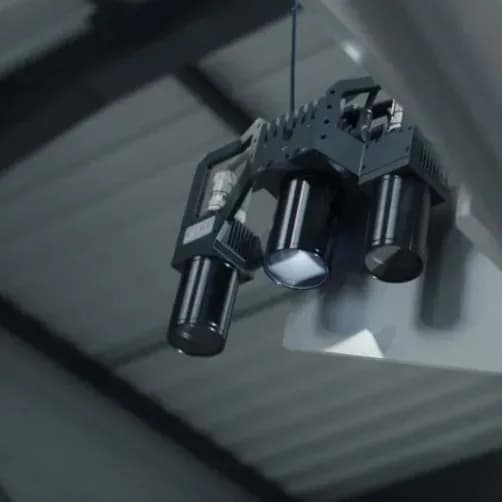
Boxes, bins, bags, bundles, flexible packages: variety is the norm, and new items are arriving faster than we can list them.
Dock lighting, reflections on the stretch film, mixed pallets, varying heights: conditions change from hour to hour and from supplier to supplier.
Without a measured position, the arm operates on a stack assumed to be straight. The first paddle out of alignment is enough to knock over the next one.
The path is just as important as the grab: avoiding the conveyor, the column, the neighboring pile, and the passing operator is all part of the decision.
A fallen package, a tilted pallet, overhang, torn plastic wrap, an item left out of the bin: what costs the most isn’t a product defect, it’s an incident.
Read a damaged, obscured, or misaligned barcode, and match the scanned package to the order: otherwise, tracking stops after the last successful scan.
On the line
3D vision provides the position, orientation, and actual dimensions of each object in the scene. The robot no longer follows a theoretical pallet layout: it picks up whatever is there, in an order that maintains the stability of the stack, and adjusts its path to avoid obstacles it detects.
This makes it possible to accept previously unseen SKUs, mixed pallets, and shipments that do not conform to the announced plan, without having to create a product record for each new item.
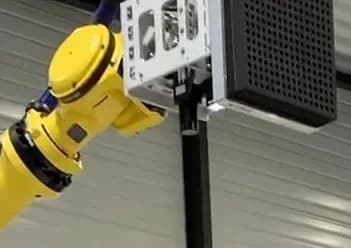
On the feed
A warehouse doesn’t produce defects; it produces events: a package that falls between two conveyors, a pallet that moves off course, a torn box, an item left in a bin. These situations are rare and varied, and that is precisely what makes them difficult to describe using rules.
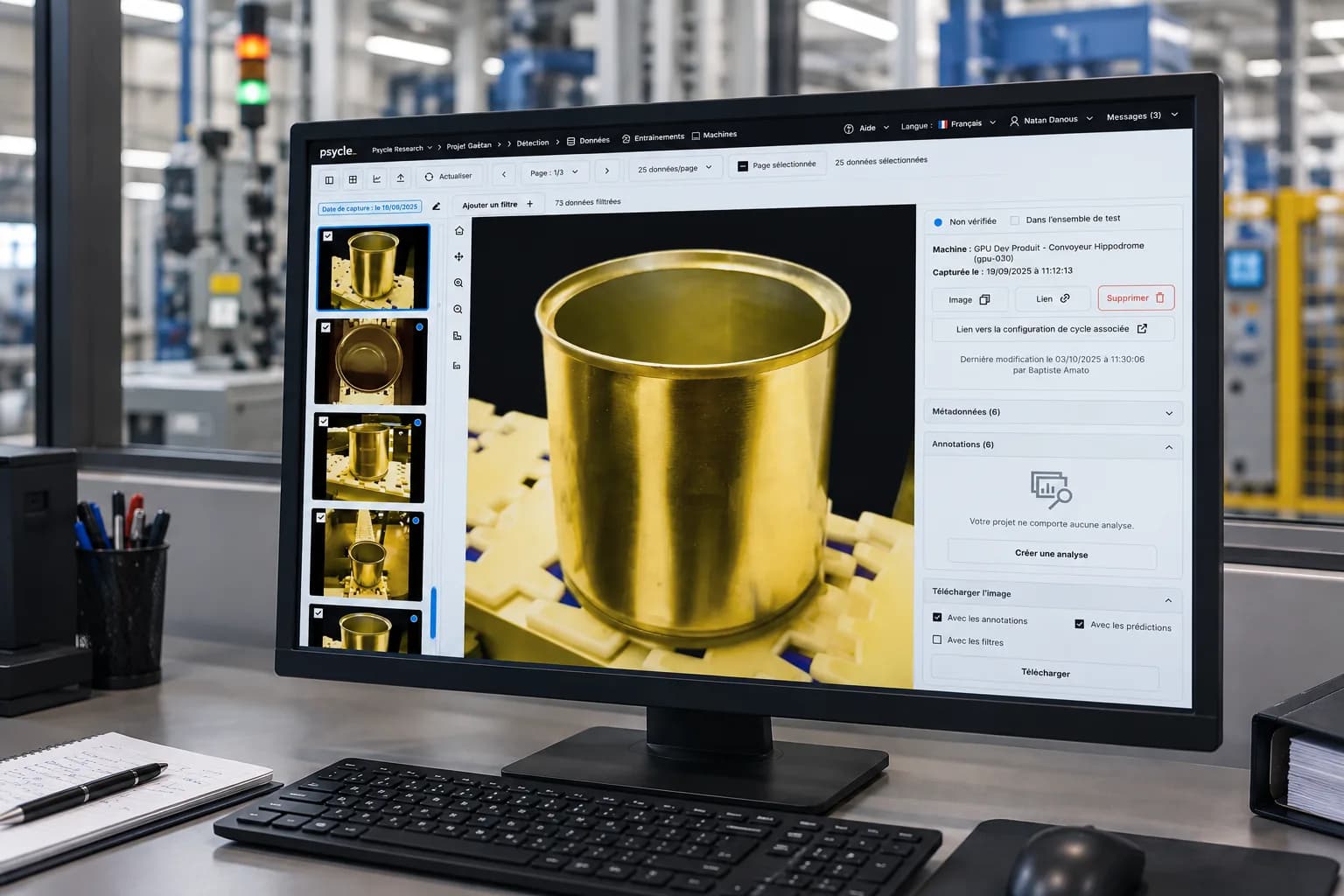
A model trained on your own images learns what a normal flow looks like in your facility and flags anything that deviates from it. Each flag is associated with its corresponding image, which makes it possible to resolve disputes, trace the cause of an issue, and track changes in a workstation over time.
use cases
Mixed layers, disorganized packages, variable heights: 3D vision algorithms detect each unit and calculate the optimal unstacking sequence for autonomous operation without human intervention.
Contact ususe cases
3D localization of loose parts allows the robot to calculate the optimal pick without a dedicated gripper or organized feeding. At Psycle, vision models adapt to the diversity of shapes and materials.
Contact ususe cases
Vision-based robot guidance positions each component with sub-millimeter accuracy for insertion, screwing or clipping operations, even when the part arrives in an uncontrolled pose.
Contact usMethod
.01
We start with a representative sample of what actually comes through: oversized packages, flexible packaging, and poorly wrapped pallets.
.02
The camera, lighting, shooting strategy, and camera paths are tested on a test rig, including frame rate and edge cases.
.03
Connection to the robot and the PLC, data transmission to the WMS, and management of manual rework and cases rejected by the cell.
.04
New packaging, new customer, new type of incident: You can handle the update on your own, without us.
A camera positioned too far away sees the scene but cannot take action; positioned too close, it sees only the set and misses the action.
| Where the camera is positioned | What the system decides | |
|---|---|---|
| Depalletizing | Above the pickup point | Pick order, pick point, and collision-free path |
| Unpacking and Preparation | Above the hopper or feed conveyor | Selecting the item to be seized, or requesting a manual return |
| Pallet inspection | After the wrapping machine or before shipment | Oversized pallets, protrusions, or torn plastic wrap reported before the truck arrives |
| Code reading | On the conveyor, before the switch | Package matched to the order; sent to the rework area if unreadable |
| Conveyor monitoring | On transfer points and drop points | Incident with date and illustration; alert if the situation recurs |
| Dock loading | At the entrance to the trailer | Verification of the count and condition of loaded pallets |
The intelligence Psycle brings is essential for obtaining a reliable result.
Julien Guinoiseau – Director
Aretec (groupe SOGAT)

With Psycle, we have reached a new level.
Charles Lestoquoy – Director
Ascodero (groupe Siléane)

Psycle is an ideal partner for developing advanced machine vision functions.
Sébastien Le Jariel – Head of Pre-Project Engineering
Himber Technologies (groupe SMB)

The partnership with Psycle opens up very interesting new possibilities for automating food processes.
Estelle Le Pape – President
MCA Process
No. The system works on what it sees: it measures the position, orientation and dimensions of each object in 3D. New product references, mixed pallets and deliveries that do not follow the announced pattern are handled without creating a product record.
Yes, that is precisely its role. The scene is measured before each pick instead of being inferred from a palletizing pattern. The robot takes into account the actual height of the stack, its tilt and any overhangs. It picks the packages in the order that keeps the stack stable.
The path is part of the decision, just like the pick itself. The calculation takes into account the conveyor, fixed obstacles, the neighboring stack and the package being gripped, so that the movement neither knocks anything over nor hits anything.
A package that has fallen between two conveyors, a pallet that is askew or out of gauge, torn film, a burst carton, an item left behind in a tote, an unreadable code. The model learns from your images what your normal flow looks like, and every alert is stored with its photo.
Yes. Commissioning includes the connection to the robot and the PLC, the upload of information to the WMS and the handling of cases that the cell rejects and sends back for manual handling.
Yes, as long as the information is still present in the image. The system reads codes that are damaged, partially hidden or misoriented, then matches the package it has read with the order. Tracking therefore no longer stops at the last successful scan.
psycle solutions
a Python framework compatible with computer vision standards (GenICam) and the latest deep learning models.