

customer story
Waste sorting
Machine vision identifies and classifies heterogeneous flows in real time by type, shape or color, to guide a sorting robot with a precision that conventional detection systems cannot achieve.
Contact usA sorting facility does not choose what comes in. The stream changes from one truck to the next, pieces arrive shredded, bent or burnt, and the belt is dirty. Vision is first used to understand what is really being processed, then to sort what can be sorted.
Machine vision watches the belt continuously and tells you what is passing: material types, proportions, piece size, presence of contaminants. Its first use is therefore to measure the real quality of a stream, at the input as well as the output of each sorting stage, where all you had before were samples taken with a shovel. On that basis, it then guides robotic sorting and flags drifts before an entire batch is downgraded.
100 %
of the stream observed
Manual characterization samples a few kilos; the gantry looks at everything that runs beneath it.
24/7
with no lapse in attention
The composition of the stream is tracked continuously, including at night and during shift changes.
2.5D
for gripping
To ensure picks at varying heights, a Z sensor is added to the 2D camera.
Industry challenges
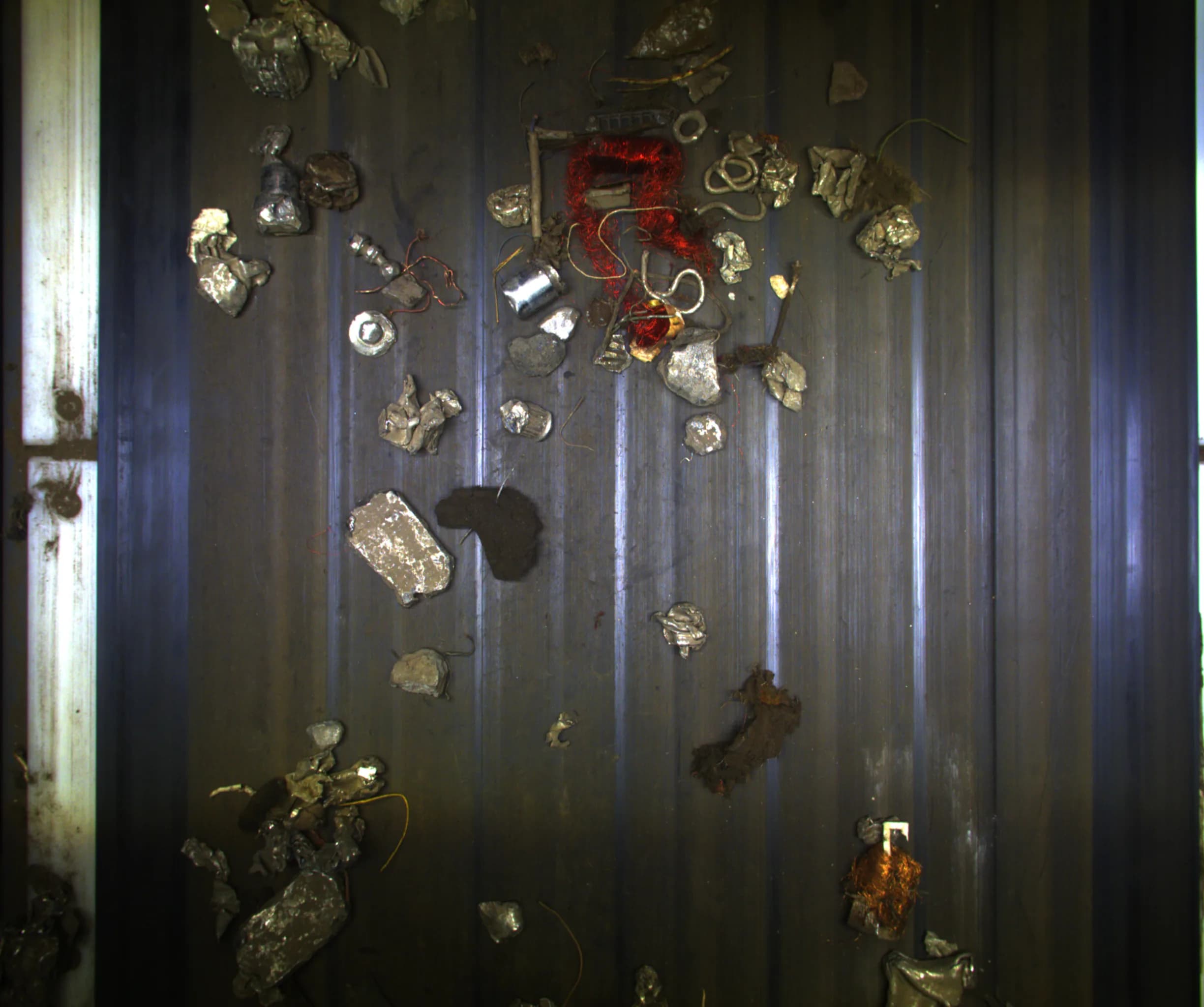
The feedstock depends on suppliers, the season and the market. No production plan says in advance what will arrive on the belt tomorrow.
Shredded, bent, crushed, burnt or soiled: the shape no longer says anything about the original product. Recognition relies on material, texture and color.
Dust, mud, moisture, vibration, pieces that overlap and hide each other: a usable image has to be obtained despite all of that, not in ideal conditions.
What was right six months ago no longer is. A frozen model slowly falls behind, with nothing to signal it if nobody measures it.
Purity rate, losses in the reject stream, actual efficiency of each separator: all figures that drive the value of the bales and that sampling estimates poorly.
A belt produces millions of images. Storing, annotating and using them takes proper tooling, not a spreadsheet.
On the line
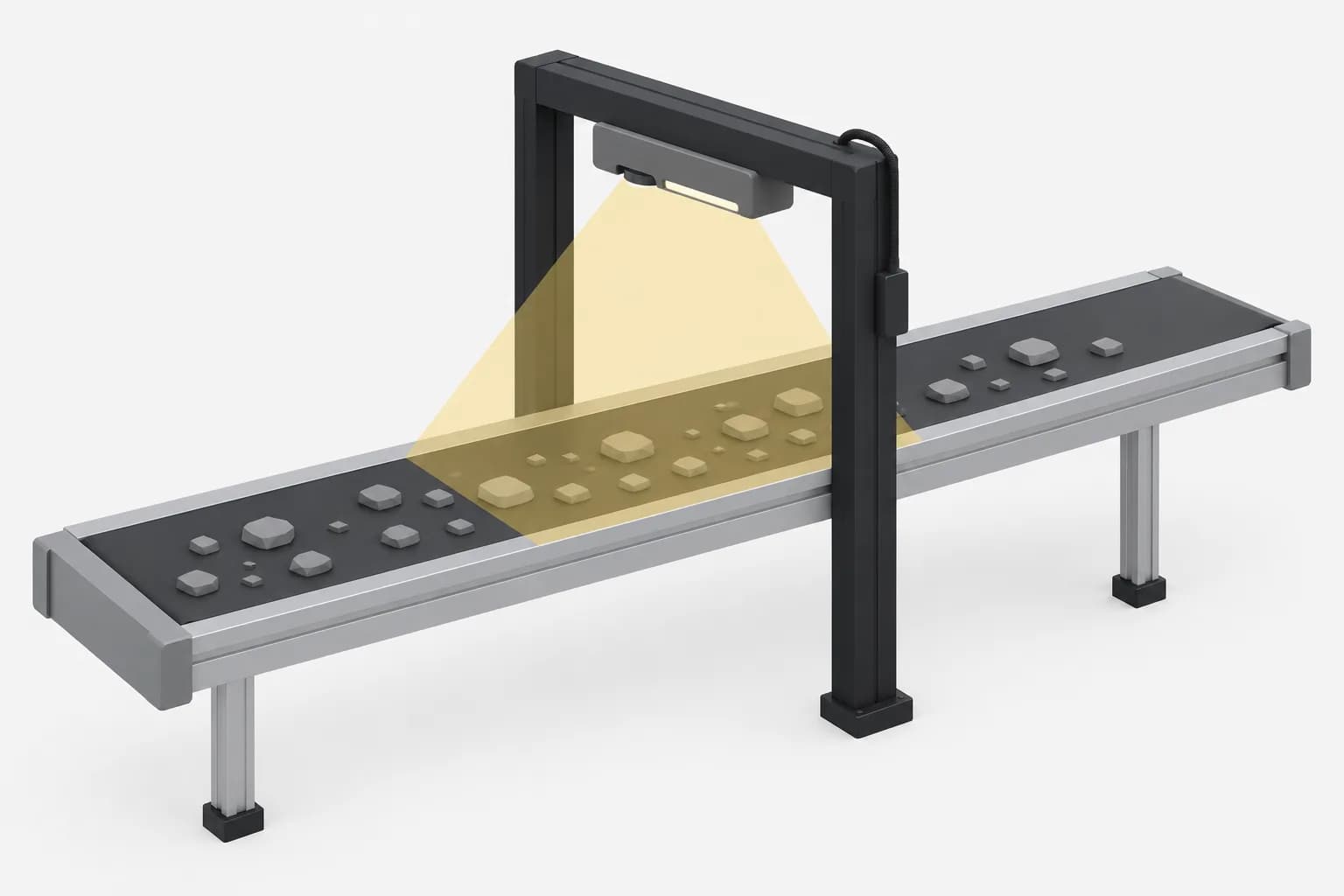
The Psycle vision gantry is installed above an existing conveyor, without touching the process. Camera, lighting and housing are sized for the dust, moisture and vibration of the line, and to produce a usable image on a belt that is never clean.
It continuously characterizes what passes beneath it, and is placed where the question arises: at the input to know what you are receiving, after a separator to measure what it lets through, before baling to qualify the bale you sell.
Under the hood
No rule written in advance describes a shredded piece. The model therefore learns from images of your stream, including the cases your operators debate, and keeps learning as the feedstock changes.
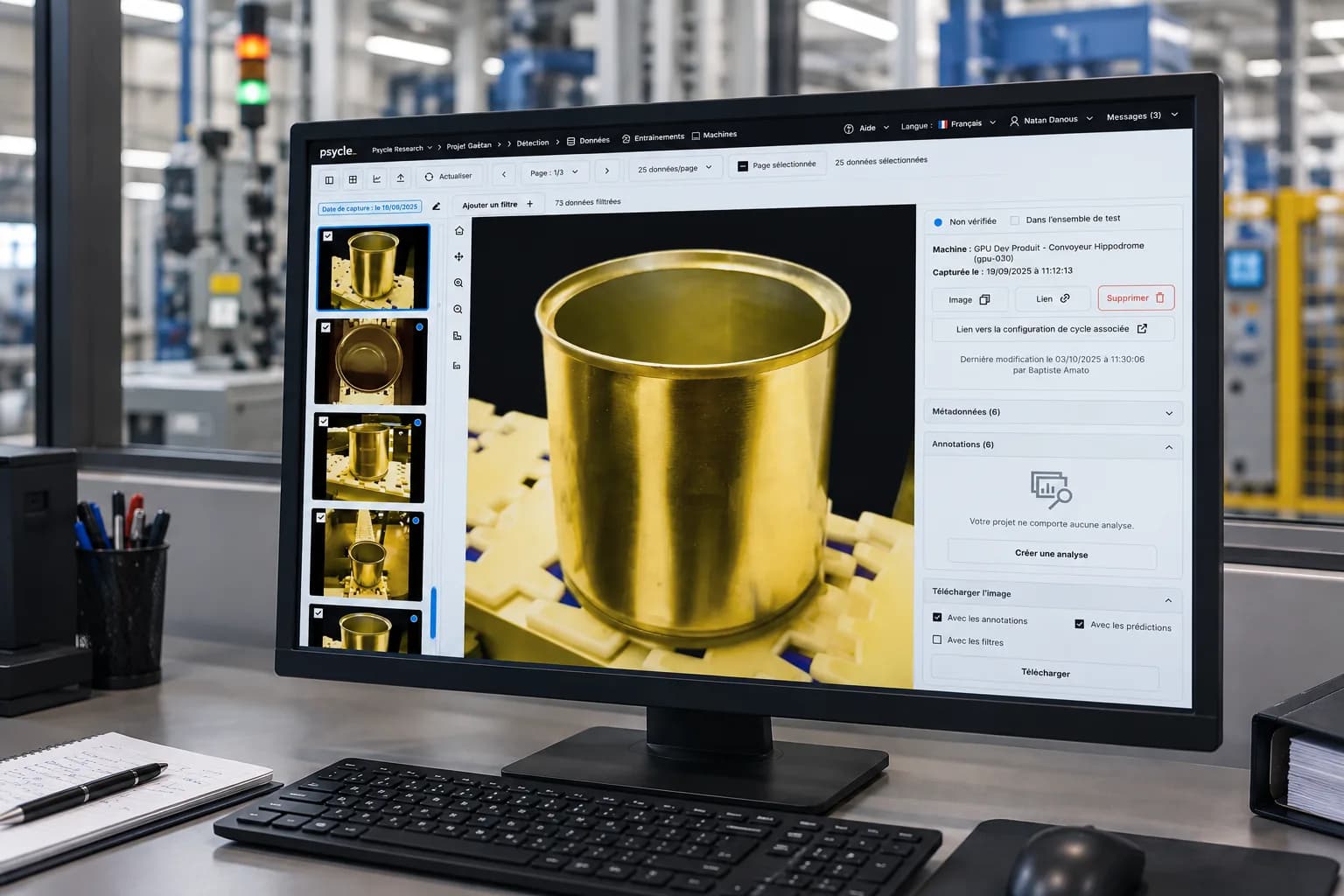
That means being able to live with large volumes: collecting without saturating the line, finding the images that matter, annotating quickly, retraining and comparing versions. That is exactly what PAQ : The Psycle quality monitoring and fleet management platform, available in both cloud and on-premises versions. does, and it is what lets your teams take over the model without going back through a service provider.
customer story
Machine vision identifies and classifies heterogeneous flows in real time by type, shape or color, to guide a sorting robot with a precision that conventional detection systems cannot achieve.
Contact uscustomer story
3D localization of loose parts allows the robot to calculate the optimal pick without a dedicated gripper or organized feeding. At Psycle, vision models adapt to the diversity of shapes and materials.
Contact usMethod
.01
The study starts from images taken on your belt. It shows which materials can be separated, at what particle size, and which cannot.
.02
A first gantry characterizes the stream and provides the training images. Many projects usefully stop at this stage.
.03
Guidance of the ejectors or the sorting robot, purity indicators fed back to your operations tools.
.04
New material, new supplier, seasonal drift: your teams retrain and redeploy without us.
Each position answers a different question, and it is the question that decides the location, not the other way around.
| Where the gantry goes | What it provides | |
|---|---|---|
| Line input | On the infeed conveyor | Composition of the incoming stream, by supplier and by truck |
| After the shredder | At the shredder outfeed | Particle size and materials present after size reduction |
| After a separator | On the sorted output and on the reject stream | Actual efficiency of the separator, and the losses it generates |
| Before baling | Before the baler | Purity rate of the batch, measured before it is sold |
| On robotic sorting | Above the picking station | Identification and position of the pieces to remove from the stream |
| On the final reject stream | Before landfill or energy recovery | Lost value, and the case for an additional sorting stage |

With Psycle, we have reached a new level.
Charles Lestoquoy – Director
Ascodero (groupe Siléane)
Yes. The gantry is installed above an existing conveyor, without modifying the process. The camera, lighting and housing are designed for the dust, humidity and vibrations of the line.
Their shape no longer says anything about the original product, so recognition relies on material, texture and color. The model is trained on images from your own flow, including the borderline cases your operators debate.
The location depends on the question you are asking:
Several gantries make it possible to monitor each sorting stage.
A frozen model gradually loses accuracy. That is why the accumulated images are used to retrain it as the flow evolves. With PAQ, your teams collect, annotate, retrain and compare versions themselves, for example when a new material or a new supplier arrives.
It largely complements it. Where sampling takes a few kilos, the gantry analyzes everything that passes, day and night, including during shift changes. It continuously tracks the composition of the flow, contaminants and particle size.
No. Many projects usefully stop at the characterization gantry: you finally know the real purity of your output, the losses in the reject stream and the efficiency of each separator. Controlling ejectors or a robot can come later, based on the images already collected.
psycle solutions
a Python framework compatible with computer vision standards (GenICam) and the latest deep learning models.