
Robot arm-mounted inspection
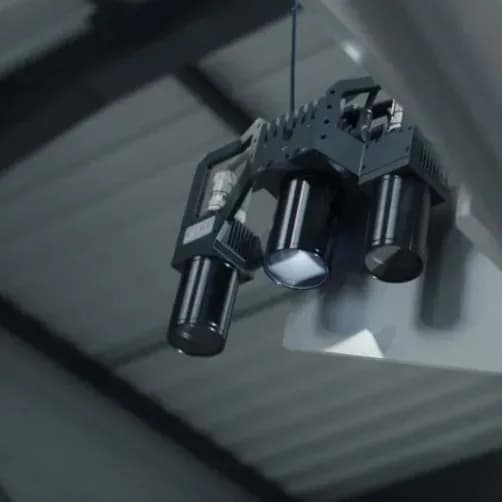
Mounting the camera directly on the robot arm makes it possible to combine guidance and quality control in a single cycle, with no dedicated inspection station, reducing line footprint and cycle time.
3D vision-based robot guidance converts an image of a scene into a path that the robot can follow, in four steps: calibration, acquisition, localization, and transformation. Each step builds on the previous one and depends on the quality of the step that precedes it.
Mounting the camera directly on the robot arm makes it possible to combine guidance and quality control in a single cycle, with no dedicated inspection station, reducing line footprint and cycle time.
Vision-based robot guidance positions each component with sub-millimeter accuracy for insertion, screwing or clipping operations, even when the part arrives in an uncontrolled pose.
Poultry, vegetables, pastries: picking non-rigid or irregular products from a bin or a moving belt requires vision that can handle deformation, glossiness and variations in shape at industrial speeds.
Mixed layers, disorganized packages, variable heights: 3D vision algorithms detect each unit and calculate the optimal unstacking sequence for autonomous operation without human intervention.
Machine vision identifies and classifies heterogeneous flows in real time by type, shape or color, to guide a sorting robot with a precision that conventional detection systems cannot achieve.
3D localization of loose parts allows the robot to calculate the optimal pick without a dedicated gripper or organized feeding. At Psycle, vision models adapt to the diversity of shapes and materials.
| 2D vision | 3D vision | |
|---|---|---|
| Measured dimensions | Width, height (X, Y) | Width, height, depth (X, Y, Z) |
| Typical use cases | Code reading, flat surface inspection | Robot guidance, unloading, volume measurement |
| Estimated cost | Lower | Higher |
.01
We carry out hand-eye calibration, fixed or robot-mounted, to guarantee consistent robot guidance accuracy throughout the cell's entire workspace.
Align the camera and robot coordinate frames in a few minutes with our guided calibration tools, with no manual matrix calculations or 3D vision expertise.
.02
We select the 3D sensor suited to your parts and your environment: stereo vision, time of flight or structured light, depending on the required accuracy.
Native drivers control the main 3D sensors on the market and deliver point clouds that are already filtered and denoised, ready for localization.
.03
Our algorithms isolate the target part and calculate its pose (X, Y, Z, Rx, Ry, Rz), taking into account obstacles and your robot's joint limits.
A geometric localization API and anti-collision functions let you define safe, optimized pick points for each product reference.
.04
We integrate communication between the vision system and your robot controller, from coordinate frame transformation to trajectory transmission.
Communication libraries transmit trajectories and coordinates with minimal latency, via sockets, EtherNet/IP or PROFINET.
Project Mode
In project mode, Psycle handles the entire integration process, from calibration to production deployment. The team performs a fixed or onboard eye-hand calibration, selects the 3D sensor best suited to the part and the environment, and then integrates the communication between the vision system and the robot cell, from coordinate transformation to the transmission of trajectories.
SDK : Psycle Assistant Production source code, open-source in Python for developers and data scientists. Mode
In SDK mode, the customer’s in-house team integrates the tools directly into its own environment, which reduces development time if 3D vision expertise is already available in-house. Camera and robot reference points are aligned in just a few minutes using guided calibration tools, and communication libraries transmit trajectories and coordinates with minimal latency via sockets, EtherNet/IP, or PROFINET.
The difference lies in where the camera is placed. With on-board vision, the module is mounted on the robot arm: it only sees what surrounds the gripper, and you have to wait for the movement to finish before observing anything else: so you depend on the cycle time. With remote vision, the camera is separate from the robot: it observes wherever you want, whenever you want, independently of the movement in progress (called "masked-time").
In industry, 3D vision is mainly used to guide robots on tasks that 2D cannot handle: picking parts from a bin, depalletizing, or locating a product whose position varies with each cycle. Psycle's applications use this real-time localization so that machines adapt to unpositioned products and variable environments, without jigs or mechanical fixturing.
The four main families are stereo vision, structured light, time of flight (ToF) and laser triangulation. Each offers a different trade-off between accuracy, speed and working distance, to be chosen according to the target industrial application.
It allows the robot to locate a part whose position is not known in advance, for example loose in a bin, and then to calculate a suitable gripping path in real time, without dedicated positioning tooling.
Psycle solutions transmit coordinate data via standard protocols (EtherNet/IP, PROFINET), which are compatible with most robot controllers on the market.
The timeline depends on the mode selected. In project mode, Psycle handles the entire integration process. In SDK : Psycle Assistant Production source code, open-source in Python for developers and data scientists. mode, the client's internal team integrates the tools into its own environment.
Every failed pick tells you something: a badly presented part, a reference never encountered before, a drift setting in. With our monitoring platform, your robotic cells no longer just run cycle after cycle: they log images of missed picks, analyze trends and alert you before the success rate drops.
psycle solutions
Localization, gripping, placement: adapt your robots' accuracy to the real constraints of your line.