
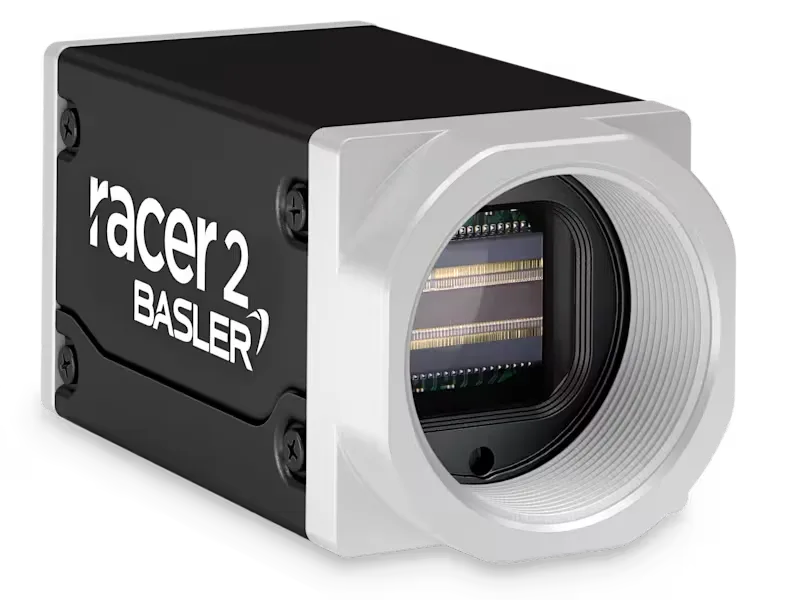
Specifications
| Type | GigE Vision colour line scan camera, racer 2 S family |
|---|---|
| Sensor | Gpixel GL3504, 2-line colour linear CMOS, global shutter |
| Resolution | 4,096 pixels per line |
| Pixel size | 3.5 × 3.5 µm |
| Line rate | 14 kHz at full resolution |
| Interface | Gigabit Ethernet, GigE Vision and GenICam |
| Power | PoE IEEE 802.3af (approx. 5.4 W) or 12 to 24 VDC via the I/O connector (approx. 3.8 W) |
| Synchronization | Hardware or software trigger, or free run |
| Lens mount | C-mount |
| Dimensions | 62.2 × 29 × 29 mm (with lens mount and connectors), under 100 g |
| Protection class | IP 30 |
| Operating temperature | −10 to +60 °C |
Why use a line scan camera rather than an area scan camera to inspect a moving product?
An area scan camera captures a whole zone at once; a line scan camera sees a single line and builds the image as the product passes by. For film, sheet metal, fabric, tiles or a rotating part, the movement itself provides the second dimension: the image has no maximum length, and its resolution along the product depends only on the line rate, not on the number of pixels of the sensor. With 4,096 pixels per line, this camera covers in one pass a width for which an area scan camera would need several stitched views.
- Seamless image: a continuous product is inspected along its whole length, with no joint between two views.
- 4,096 pixels of 3.5 µm and up to 14 kHz: width resolution and line rate are set independently.
- Two-line colour sensor (one green line, one alternating red and blue): hue separates a stain or an appearance defect that a greyscale image lets through.
- A single Gigabit Ethernet cable, with PoE power possible: no frame grabber needed.
- Hardware trigger on an opto-isolated input: lines are paced by the machine encoder, not by a clock.
Psycle does not only resell this camera: it integrates it. The sensor provides the image; what is drawn from it depends on the lighting, the vision software running behind it and the model trained on the line’s real defects. The same racer 2 does not see the same defects under low-angle lighting, bright field or transmission.
A line scan camera is justified when the product moves at a steady speed and the inspection must cover its whole surface: surface inspection of strips, films, sheets and plates, appearance and colour checks, detection of scratches, stains or visible foreign bodies. Inspection covers 100% of the surface, at line speed.
Before installing
Three points that decide the rest
The line rate follows from the speed, not the other way round. For square pixels, the line period must match the time the product takes to move by one object pixel. Worked example: a 400 mm field over 4,096 pixels gives roughly 0.1 mm per pixel; at 14 kHz, the product can move at 1.4 m/s at most. Beyond that, either resolution along the product is reduced, or another camera is needed. An encoder on the machine paces the lines, so speed becomes a setting variable, not an assumption.
Lighting matters more than the sensor. At 14 kHz, a line lasts about 71 µs at most: exposure is short, so the light must be intense, uniform across the full width and stable. A line light (bar or backlight) is chosen together with the camera, and its alignment with the viewed line counts as much as its intensity.
Check the data rate before fixing the line rate. At 14 kHz over 4,096 pixels, the sensor produces about 57 million pixels per second; in colour, depending on the pixel format chosen, the data rate can approach or exceed what a Gigabit Ethernet link carries. The housing is IP 30: in dusty or wet environments, it goes in an enclosure.
Documentation