Foreign object detection

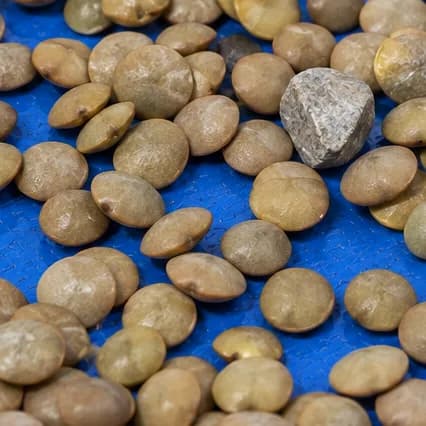
In the food industry, a foreign object is not merely a cosmetic defect: it’s a health risk, a product recall, and damage to the brand. Machine vision inspects 100% of products, from sausage casings to seal closures, at production speed. It complements your X-ray and metal detectors by detecting what they miss: plastic, glass, plant matter, and film.

What foreign objects does machine vision detect in the food industry?

Defects vary depending on the product: here’s what we inspect across four product categories.

Sausages and deli meats
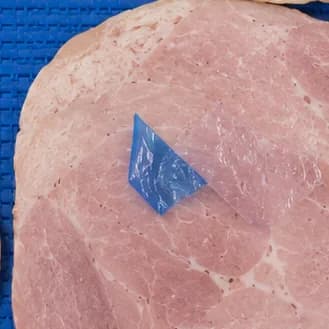
5 contrôles

  • Piece of intestinedetection of loose pieces of intestine or skin
  • Cliplocating a loose clip inside or on the product
  • Plastic or filmdetection of plastic or packaging film
  • Bones and cartilageidentification of residual bone or cartilage fragments
  • Foreign object on the surfaceinspection of the product's surface
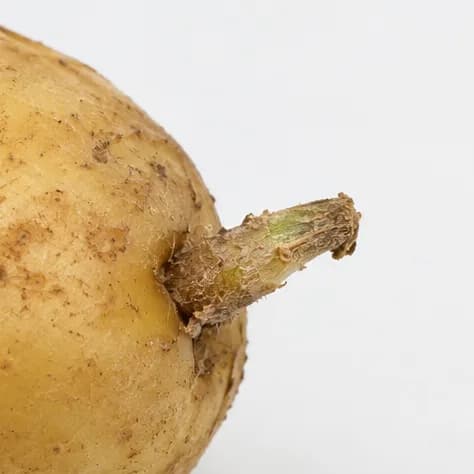
Fruits and vegetables

7 contrôles

  • Stemdetection of residual stems and stalks
  • Leafdetection of leaves, including green ones on green fruit
  • Core or seeddetection of remaining cores and seeds
  • Wooddetection of splinters and pieces of wood
  • Stonedetection of stones and clumps of soil
  • Harvesting plasticidentification of plastics from the harvest
  • Insectdetection of insects on and inside the product

Vrac et matière première

4 contrôles

  • Glassdetection of glass fragments in the melt using polarized imaging
  • Conveyor belt rubberdetection of pieces of tape or sealant
  • Glove or bandagedetection of misplaced protective or medical equipment
  • Metalidentification of metal fragments visible on the surface

the challenge

Why foreign bodies are the hardest defects to detect

fibre_corps_etranger

Unpredictable

Its shape, color, and position change each time it appears: no single rule is sufficient.

Rare

It occurs infrequently, so there are few images of defects available to train an AI.

Camouflaged

A bone in a piece of meat, a leaf on a green fruit, glass in a stream of raw material: the foreign object blends in with the product.

Variable

The product itself varies from batch to batch (fruit, deli meats), which makes it difficult to distinguish between normal variation and a defect.

artificial intelligence

Supervised or unsupervised: two ways to detect, one goal

Psycle offers both approaches. We recommend supervised AI, which accurately categorizes the type of foreign object; unsupervised AI feeds into it by revealing what no one had anticipated.

Supervised AI (our baseline approach)Unsupervised AI
PrincipleLearn from examples of foreign objects annotated by type.Learn what a compliant product looks like and report any discrepancies.
StrengthsIdentifies and categorizes the exact type of foreign object (plastic, bone, glass, plant matter, etc.), which helps pinpoint the cause. Highly reliable for known defects, with few false alarms once trained.Start with images of compliant products only. Identify any foreign objects that have never been encountered before, which is useful for rare or unpredictable defects.
LimitsRequest for defect images to be collected and annotated: For industrial-scale performance, allow for at least 500 instances per type of foreign object. It cannot recognize what it has never been trained on.Flags as “abnormal” without specifying “what.” More sensitive to natural variability in the product: risk of false rejections, and human review required.
TogetherIt receives unknown cases labeled by humans and becomes more accurate with each cycle.Detects the unexpected and feeds the supervised database after human verification.
When to choose ItIdentified and recurring defects; traceability by type of foreign object.Starting without a fault database, detecting unexpected events, building the database.

Looking for
integration advice?

Discover our standard solution for inspecting sealed trays: cells, lighting, line speed and interfacing already proven in the field.

See the industry solution

imaging technologies

Appropriate imaging for each foreign object

No technology can detect everything. The choice is validated on your products through testing on your samples.

Visible color

Colors and shapes.

Color imaging highlights differences in color and shape—such as vegetation, colored plastic, insects, or stones on the product.

Infrared and NIR

Beyond the visible.

NIR and infrared reveal differences in material that the naked eye cannot see: bone, wood, or plastic that is the same color as the product.

Polarized light

Transparency revealed.

The polarized camera highlights transparent glass or plastic in a stream of raw material, where otherwise only reflections are visible.

3D, hyperspectral

Relief and spectrum.

3D technology detects variations in terrain, while hyperspectral imaging analyzes the spectral signature of the object when color alone is no longer sufficient.

A complement to X-rays, not a replacement

Two technologies, two perspectives

  • Together, they cover risk management.

X-rays

Dense bodies

Take a look inside the product and the packaging.

Where density creates contrast.

  • Metal
  • Glass and stone, depending on their thickness and density
  • Dense material inside the product

machine vision

What X-rays miss

Check the surface and the sealed areas.

Where the texture or color creates the contrast.

  • Lightweight plastic and film
  • Plant, bone, insect
  • Failure to cap and seal

compliance

A compliance issue as much as quality

Regulation (EC) No. 178/2002

Legal requirement

It prohibits the placing on the market of a dangerous food product, which excludes any product containing a foreign object that could cause injury.

Hazard analysis

Method

Foreign material control is part of the hazard analysis component of the HACCP approach.

IFS and BRC standards

Certification

IFS Food and the BRC Global Standard for Food Safety require demonstrated control of foreign objects.

Evidence of inspection

What Psycle offers

Each inspected product is time-stamped, and an image of it is archived, which is useful during an audit or in the event of a complaint.

Frequently Asked Questions regarding foreign object detection.

Go to the FAQ

Peut-on détecter un corps étranger transparent ou de la même couleur que le produit ?

Oui, en choisissant l’imagerie adaptée. La lumière polarisée fait ressortir le verre ou le plastique transparent dans un flux de matière première, et le proche infrarouge distingue des matières de même teinte que le produit, comme un os ou un morceau de bois. Le montage optique est validé sur vos échantillons avant tout engagement de matériel.

IA supervisée ou non supervisée : laquelle choisir pour détecter des corps étrangers ?

Nous recommandons l’IA supervisée, qui catégorise le type exact de corps étranger détecté. L’IA non supervisée la complète : elle signale tout écart par rapport à un produit conforme, y compris un corps étranger jamais rencontré. Après qualification humaine, ces cas alimentent la base supervisée, qui gagne en précision à chaque cycle.

Combien d’images de corps étrangers faut-il pour entraîner le système ?

Pour une performance industrialisable, il faut partir sur une base d’au moins 500 occurrences par type de corps étranger. Ce volume permet d’absorber la variabilité d’une production agroalimentaire. Le chiffre exact dépend du produit ; l’IA non supervisée aide à réunir ces images lorsque les défauts sont rares.

La vision industrielle remplace-t-elle les rayons X ?

Non, elle les complète. Les rayons X détectent les corps denses, dans la limite de leur épaisseur et de leur densité ; la vision industrielle voit en surface et dans les zones de scellage ce qu’ils manquent : plastique léger, film, végétal, insecte, défaut d’operculage. Les deux technologies se combinent dans une démarche de maîtrise des risques.

Que devient un produit dans lequel un corps étranger est détecté ?

Le système signale le produit non conforme à votre ligne, qui l’écarte selon votre configuration. L’image du produit est horodatée et archivée : vous disposez d’une trace de contrôle en cas d’audit ou de réclamation.

psycle solutions

A foreign object in your products must not reach the consumer.

Machine vision inspects each product at the production rate.